
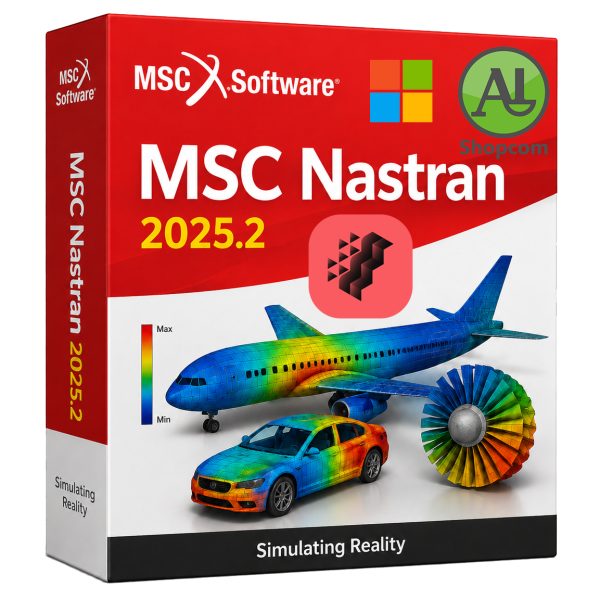
MSC Nastran 2025.2
121218 DT
Added on June 13, 2026 - 17:13:06
Download link :
https://www.shopcom.tn/product/msc-nastran-2025-2/download
Payment :
https://www.shopcom.tn/payment
MSC Nastran 2025.2: The Industry Standard for Structural Analysis
MSC Nastran 2025.2 is the latest version of the renowned Finite Element Analysis (FEA) solver, now under the Hexagon portfolio. It remains the gold standard for solving complex structural, dynamic, and thermal engineering problems across aerospace, automotive, defense, and marine industries. This release continues the software’s legacy of high-precision simulation while introducing significant performance upgrades for nonlinear analysis, optimization, and solver efficiency.
Core Analysis Capabilities
At its heart, MSC Nastran provides a comprehensive suite of analysis types essential for modern engineering validation. These include linear and nonlinear static analysis for stress and deformation, dynamic analysis (including transient, frequency response, random vibration, and shock/impact analysis), real eigenvalue analysis for natural frequencies and mode shapes, thermal analysis for heat transfer and steady-state temperatures, and acoustic-structure coupled analysis for noise and vibration studies. It also features advanced design optimization and topography/topometry optimization to guide lightweighting and performance improvements.
Key Enhancements in Version 2025.2
1. Advanced Nonlinear Solver Performance (SOL 400)
A primary focus of the 2025.2 release is the dramatic improvement of nonlinear analysis capabilities, specifically within SOL 400 (Implicit Nonlinear). The update introduces a new high-performance nonlinear solver path referred to as NLPERF
. This new architecture utilizes an updated DMAP (Direct Matrix Abstraction Program) sequence and the MUMPS sparse solver, which offers superior parallel scalability. Users can expect faster runtimes and better scaling on multi-core systems—up to 32 cores for these advanced nonlinear simulations.
2. Multi-Disciplinary Co-Simulation (MSC CoSim)
Version 2025.2 tightens the integration between MSC Nastran and other simulation tools. The coupling with Adams (multibody dynamics) now supports the new high-performance nonlinear solver, allowing for more efficient co-simulations of flexible bodies undergoing large deformations. Furthermore, region-aware load mapping has been introduced for workflows involving scFLOW (CFD). This allows multiple aerodynamic or thermal loads from a CFD analysis to be accurately mapped to specific regions within an FE model, reducing manual data processing and increasing fidelity for FSI (Fluid-Structure Interaction) problems.
3. Frequency Analysis & Optimization
For users performing eigenfrequency analysis, MSC Nastran 2025.2 (in conjunction with tools like MSC Apex) facilitates the creation of point masses that automatically influence optimization routines, allowing engineers to prevent resonance by shifting natural frequencies away from excitation forces. The software also supports real hybrid modes, using residual vectors to improve the accuracy of dynamic flexibility and modal participation in large systems.
4. Solver & Data Management Improvements
-
Automated Multi-Level Substructuring (AMSR): The static reduction of external superelements is now up to 10 times faster, thanks to a new automated method that does not sacrifice solution accuracy.
-
Memory & Disk Management: Improved Out-Of-Core (OOC) and Distributed Memory Parallel (DMP) support for the MUMPS solver reduces disk space requirements via Reduced Impedance Matrices (RIM).
-
Simplified Transfer Path Analysis (TPA): A new “Single-Step TPA” capability simplifies job setup and submission for NVH engineers, making it faster to identify which structural paths contribute most to noise/vibration issues.
5. Post-Processing & Outputs
-
CSV Outputs for SOL 128: Nonlinear displacements and loads can now be exported directly to CSV format for easier external analysis.
-
Adams .mnf File Support: Modal Neutral Files (MNF) for Adams now support the recovery of acoustic pressure and rotational dynamics effects without requiring a full restart analysis.
Integration with MSC Apex 2025.2
To complement this solver update, the MSC Apex 2025.2 pre/post-processor introduces specific features that leverage the new Nastran capabilities. These include “Linear Gap” contact for simulating compressive-only interfaces without nonlinear penalty methods, and significant speed improvements for modeling tied contacts between non-conforming meshes.
Platform and Availability
MSC Nastran 2025.2 is available for Windows and Linux environments, with specific builds identified by the executable name nast20252. It supports advanced superelement reduction techniques (e.g., parameter RVEL) and is compatible with third-party delivery databases (DDB) used for acoustic and vibration analysis (e.g., AMLS 5.3).
Produits similaires
-

ZBrush 2026.1.1
3017 DTAdded on March 6, 2026 - 04:21:10
592 Download -
Adobe Substance 3D Painter V12.1.0
597 DTAdded on July 2, 2026 - 09:55:32
194 Download -
IBM SPSS Statistics 27
11364 DTAdded on March 17, 2026 - 13:10:36
390 Download -
SketchUp 2026 V26.0.429
3273 DTAdded on December 21, 2025 - 12:38:26
493 Download
Avis
Il n’y a pas encore d’avis.